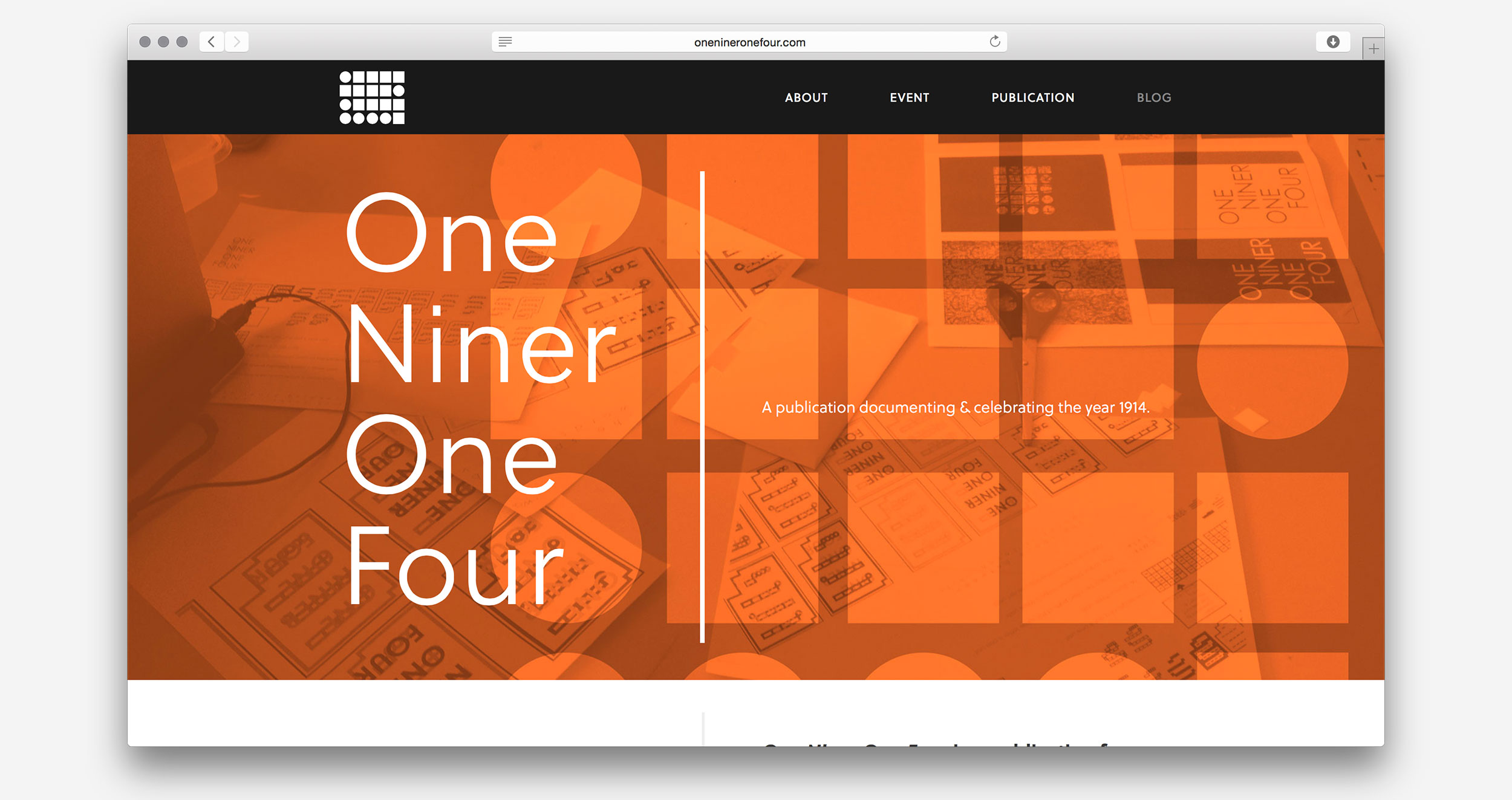
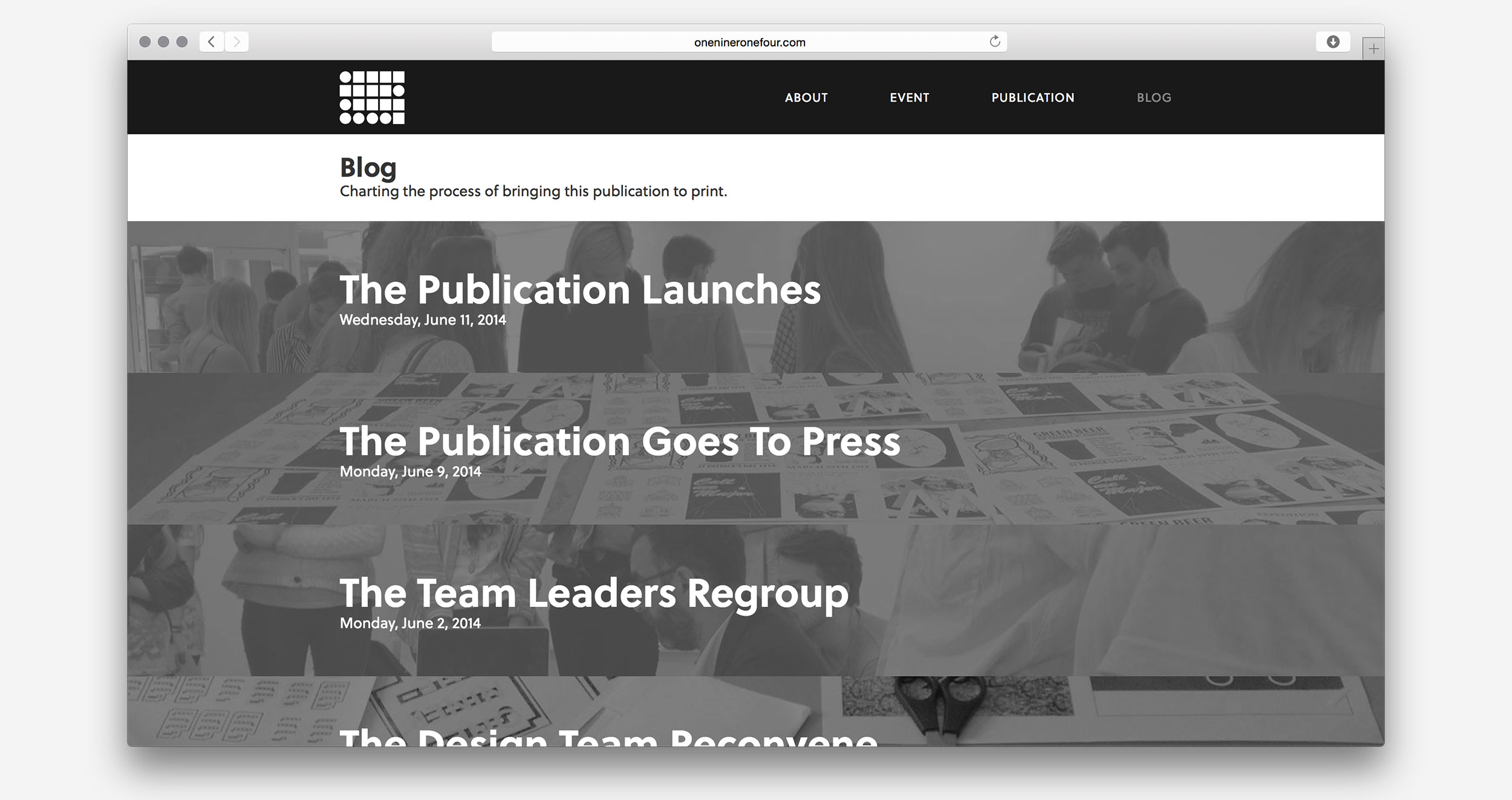
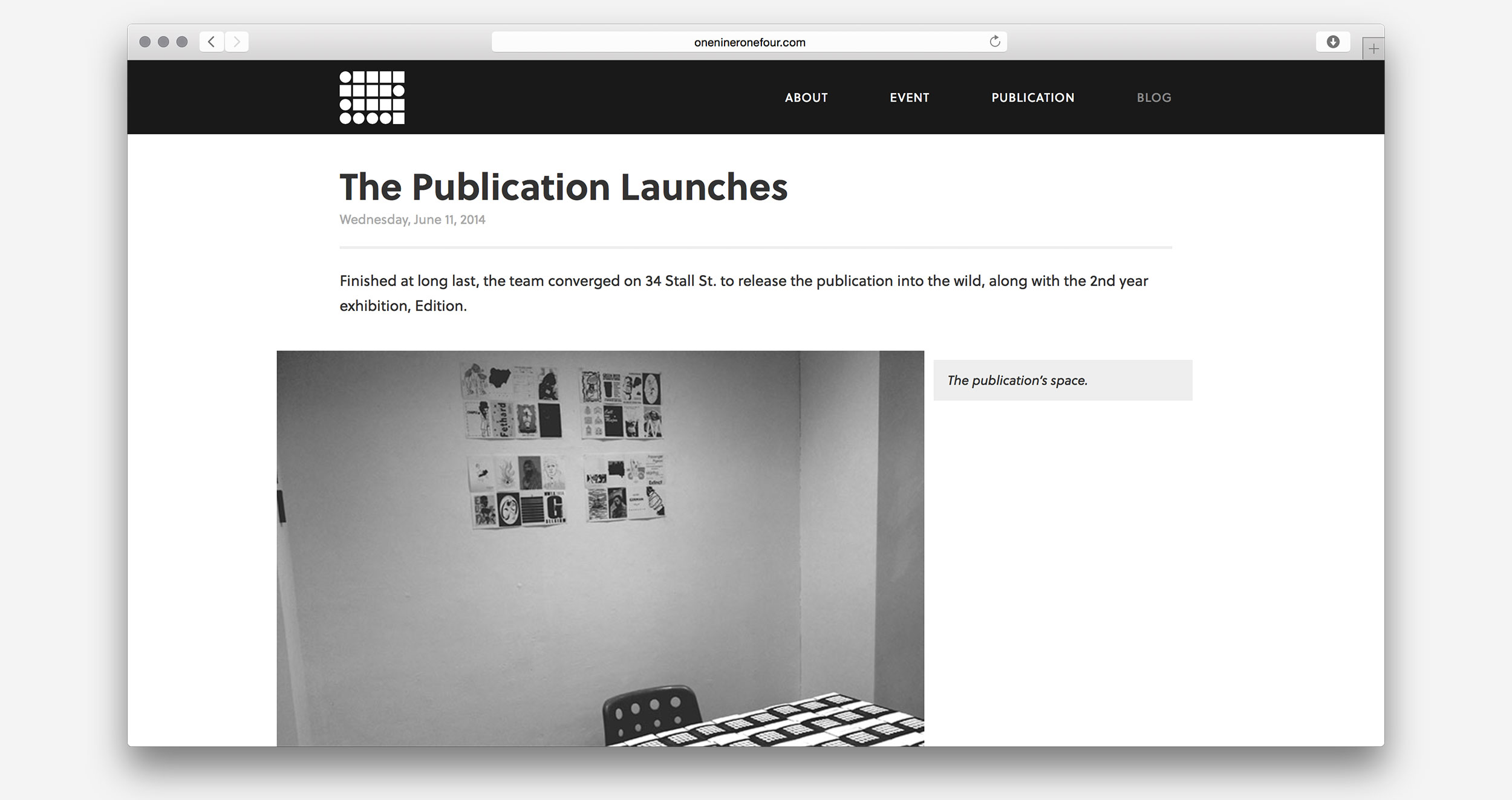
One Niner One Four is an exhibition and set of prints that documents and celebrates the year 1914. To publicise the exhibition, I was tasked with creating a website which documented the creation of this publication.
My challenge was to transition a brand designed for print over to the internet — to create something that felt true to the print spirit of the publication, but also to the inherent aesthetic of the web.
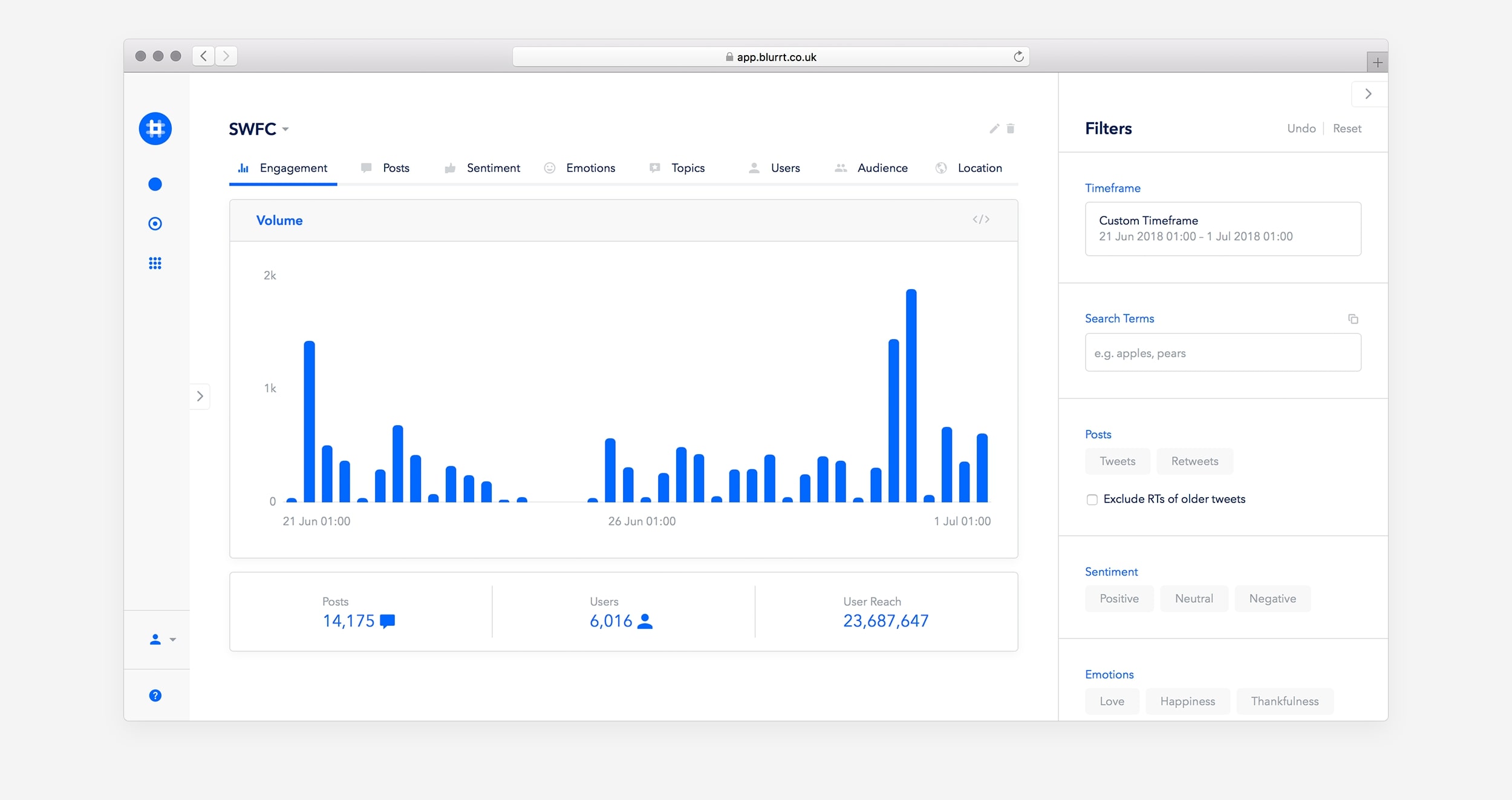
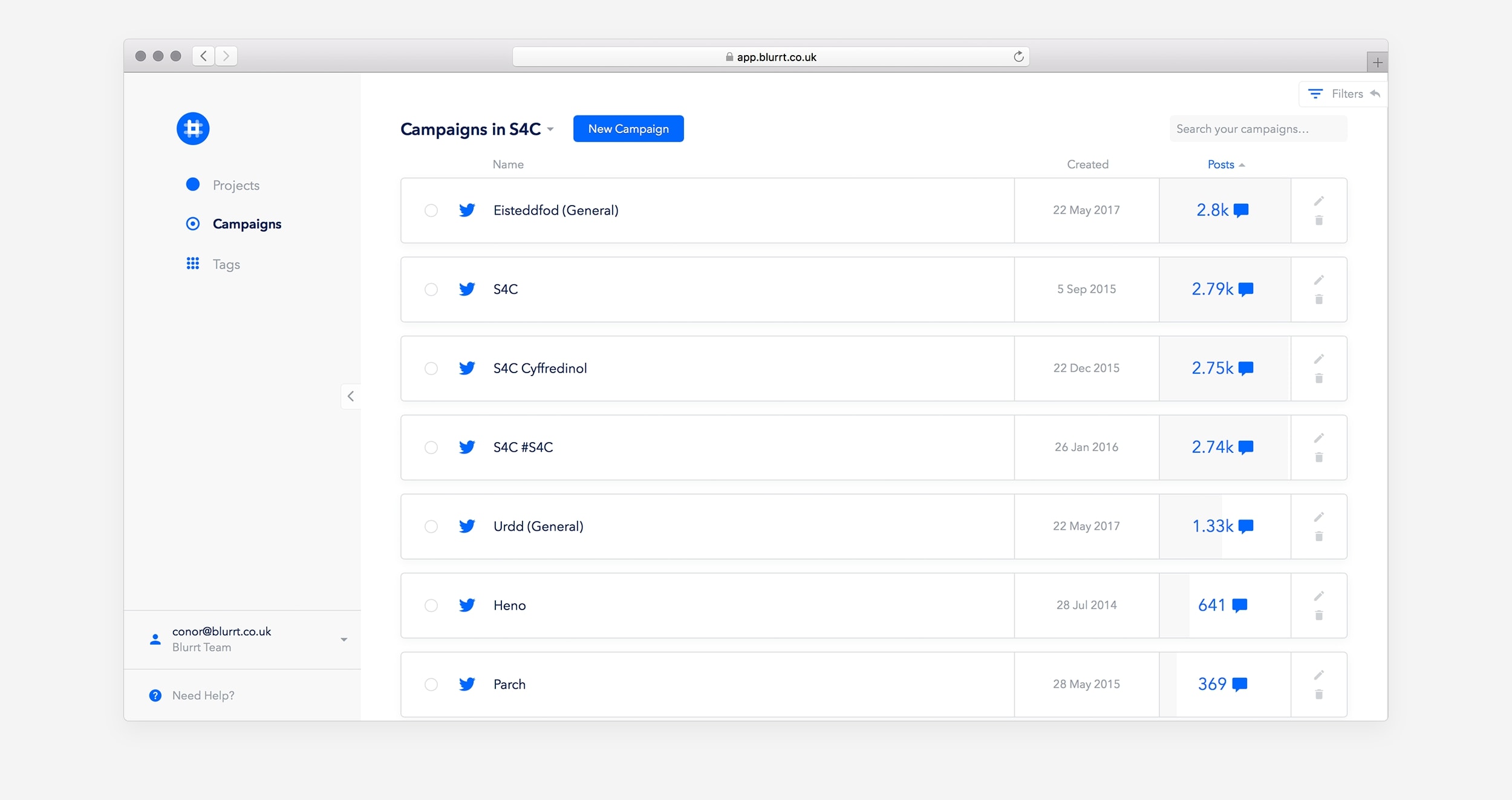
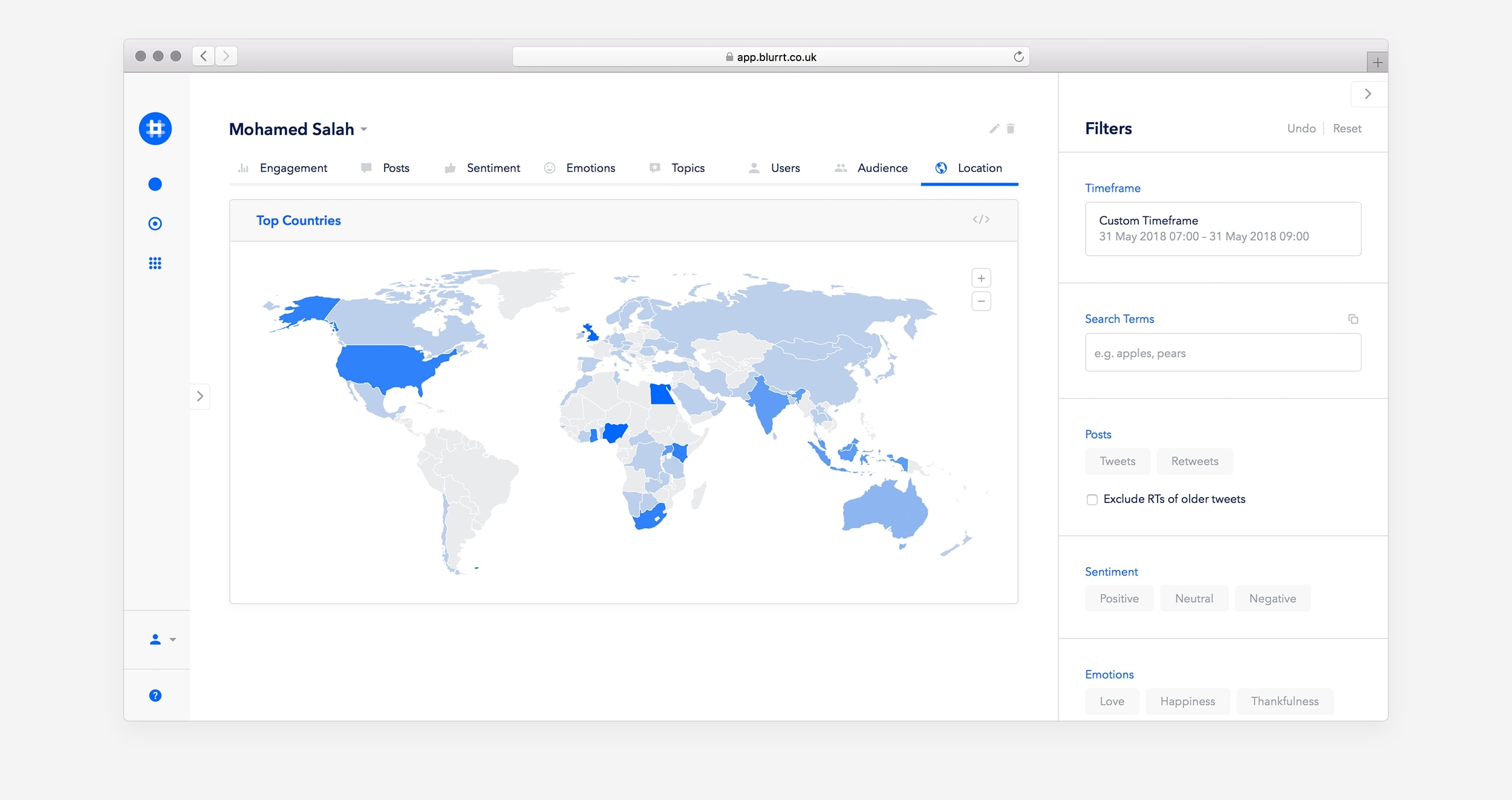
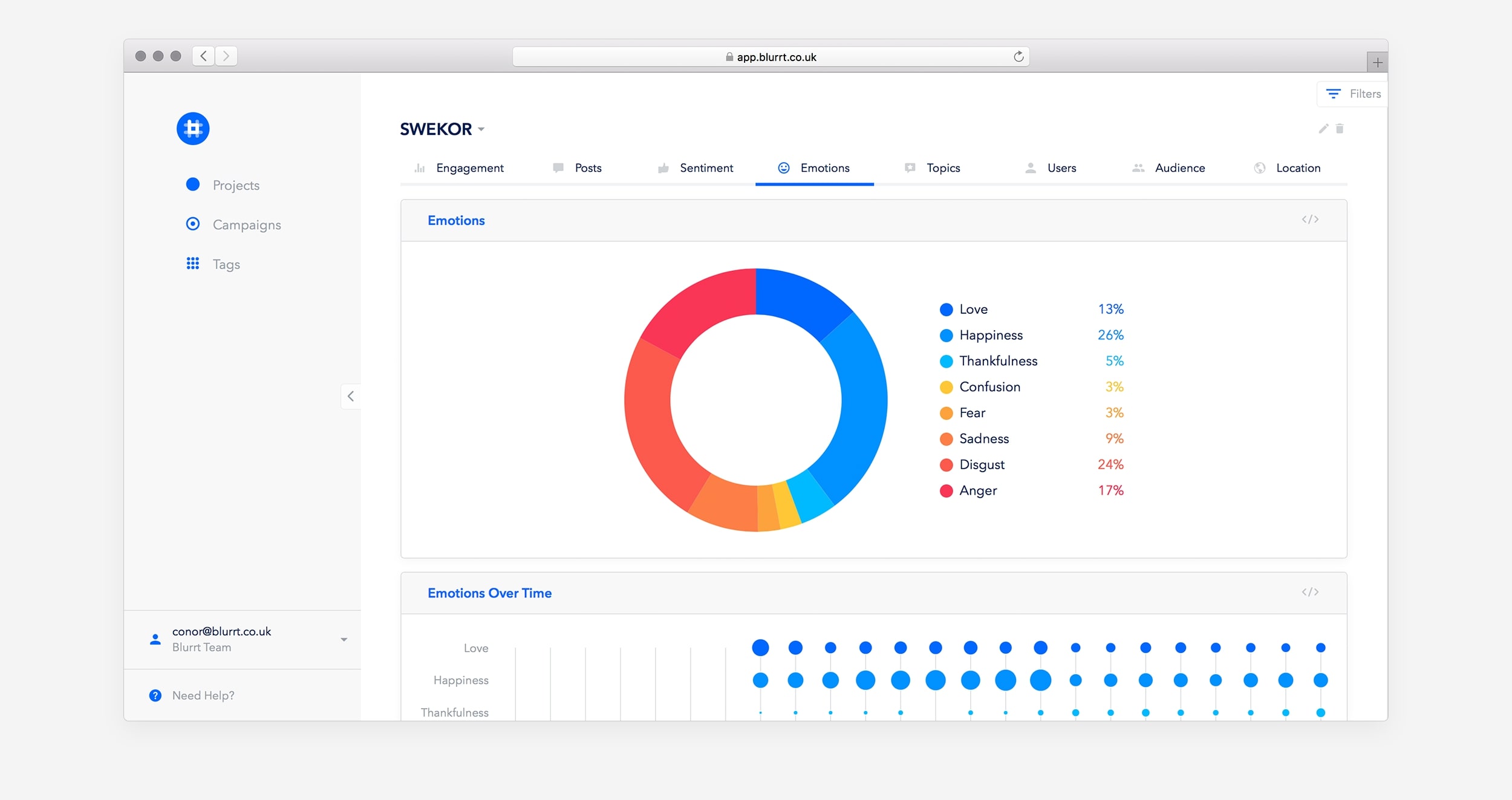
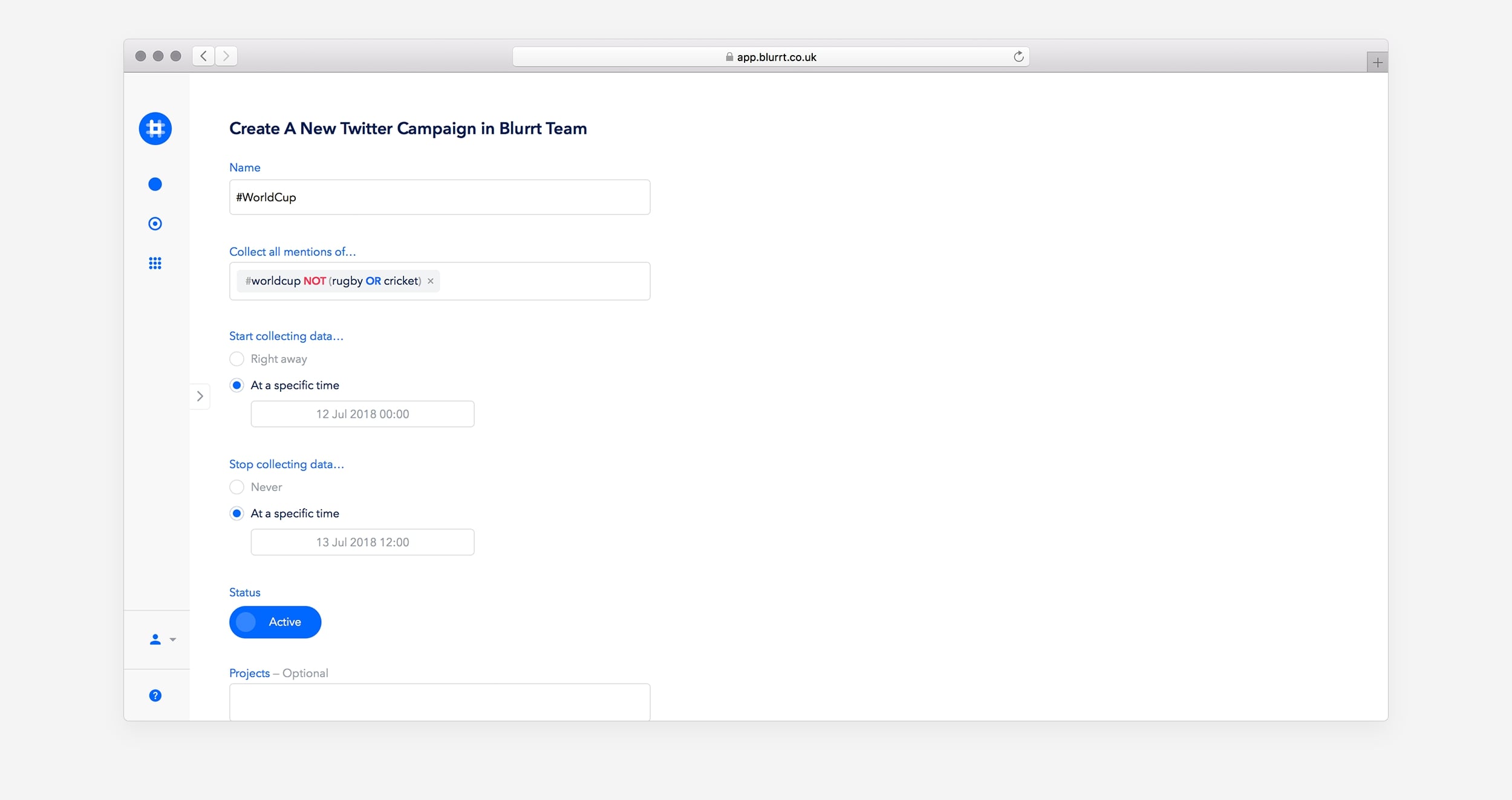
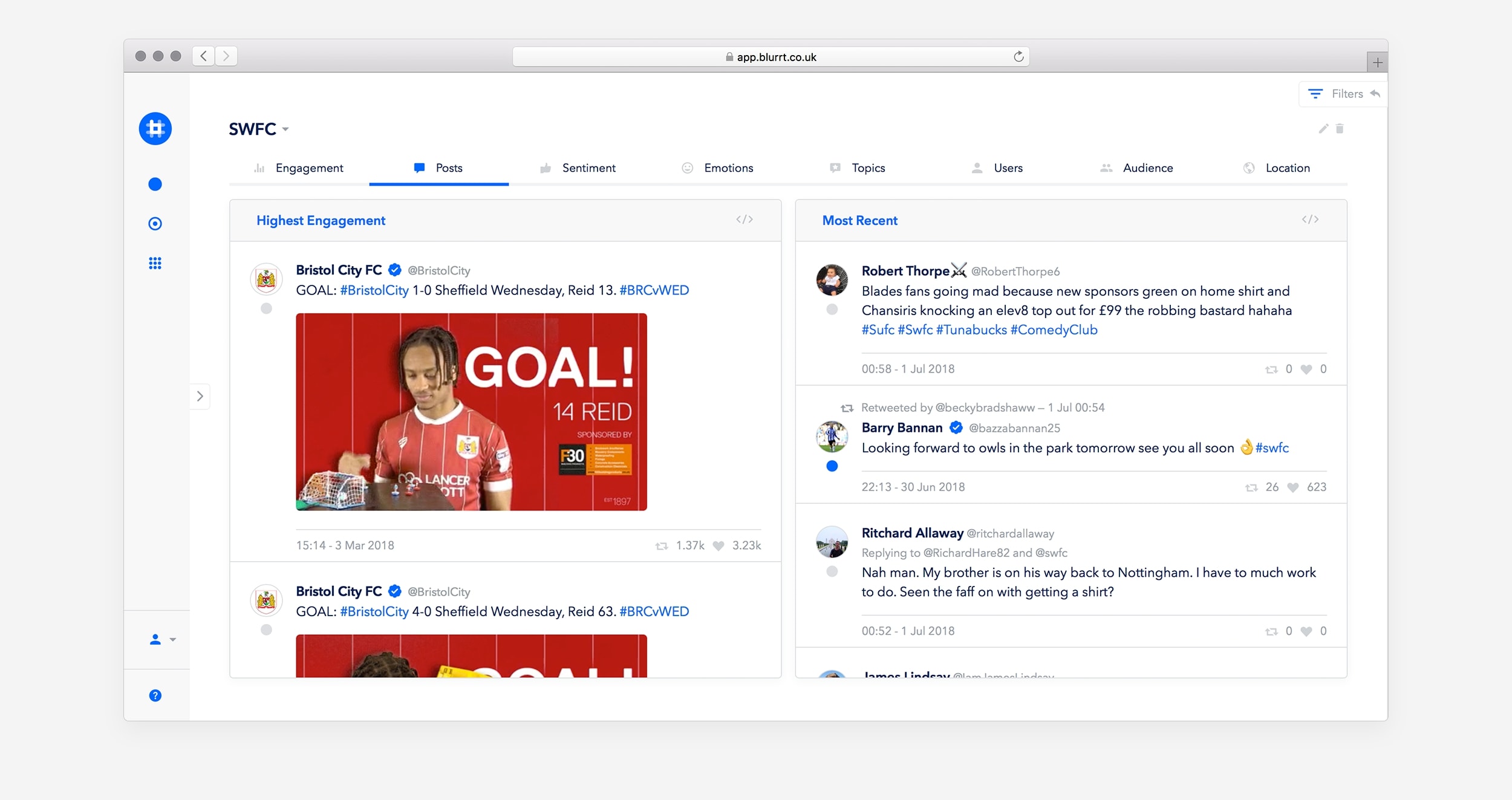
Blurrt is a social media analytics platform — collecting posts on a topic and revealing the trends behind the conversation.
As an in-house designer, I was tasked with redesigning the core app from scratch. This involved running workshops to gather requirements, and restructuring the site for a simpler user flow. How do you create an app that is not daunting for basic users, but that still allows power-users to get very advanced very quickly? How do you make a data analytics platform feel… fun?
As well as being solely responsible for the UX & UI on this project, I also led the front-end development. I was able to reduce size of the JavaScript codebase by over 95% (from 2.5mb minified down to 70kb), without any loss of functionality.
“Even the most perfect reproduction of a work of art is lacking in one element: its presence in time and space, its unique existence at the place where it happens to be.” — Walter Benjamin
Early January this year, my girlfriend and I visited Paris. We were only there for two days, and, as it was my first time in the city, our itinerary was stuffed with all of the things one feels one must do when visiting Paris — the Eiffel Tower, Notre-Dame, the Musée d’Orsay, the Musée de l’Orangerie — and, of course, the Musée du Louvre.
The Louvre is the archetypal museum — when one thinks of a museum, one thinks of the Louvre. The place itself — those stark glass pyramids against the ornamented buildings that surround them — is a symbol of art as much as the pieces contained within it are. Whilst the Orsay has a more interesting collection, and the Orangerie is more serene, it is the Louvre which seems to say “You are now Looking At Art.”
There is, however, one piece of art in the Louvre which says this more so than the building itself — Leonardo’s Mona Lisa. Say the word “art” to an eight-year-old, she will likely think of this painting. It has been reproduced ad infinitum — if I were discussing any other painting, I would now place an image of it into the post: with the Mona Lisa, there seems no point.
Upon arriving in Paris, we dumped our bags at the apartment in which we were staying, and immediately made our way to the Louvre. We were eager to Look At Art.
In the main hall of the Louvre are entrances into the various wings of the museum, each labelled with names that gave little away as to what was within. We could have found ourselves a map and navigated the place sensibly, but we let chance guide our visit — we picked a wing at random, and wandered in. There wasn’t much in particular that we wanted to see at the Louvre — aside from the Mona Lisa, that is.
The wing we found ourselves in contained the Louvre’s ancient Egyptian collection — a fascinating exhibit, but we found — after about an hour — that there are only so many sphinxes, sarcophagi & eye-hieroglyphs that one can see on any given day, and we returned to the main hall.
Starting to feel hungry, and still tired from the flight over, we decided we’d go see the Mona Lisa, whatever pieces we encountered along the way, and then leave.
Not wanting to leave it to chance again, my girlfriend went to the information desk to find out which wing the Mona Lisa was in. Not only were we told which wing, but which floor, and where to go on that floor. Easy — we’d make a beeline for the piece, and then go grab some food.
Once in the appropriate wing, we began to see signs leading us towards Leonardo’s masterpiece. Even easier. Just follow the signs — we’d be there in no time.
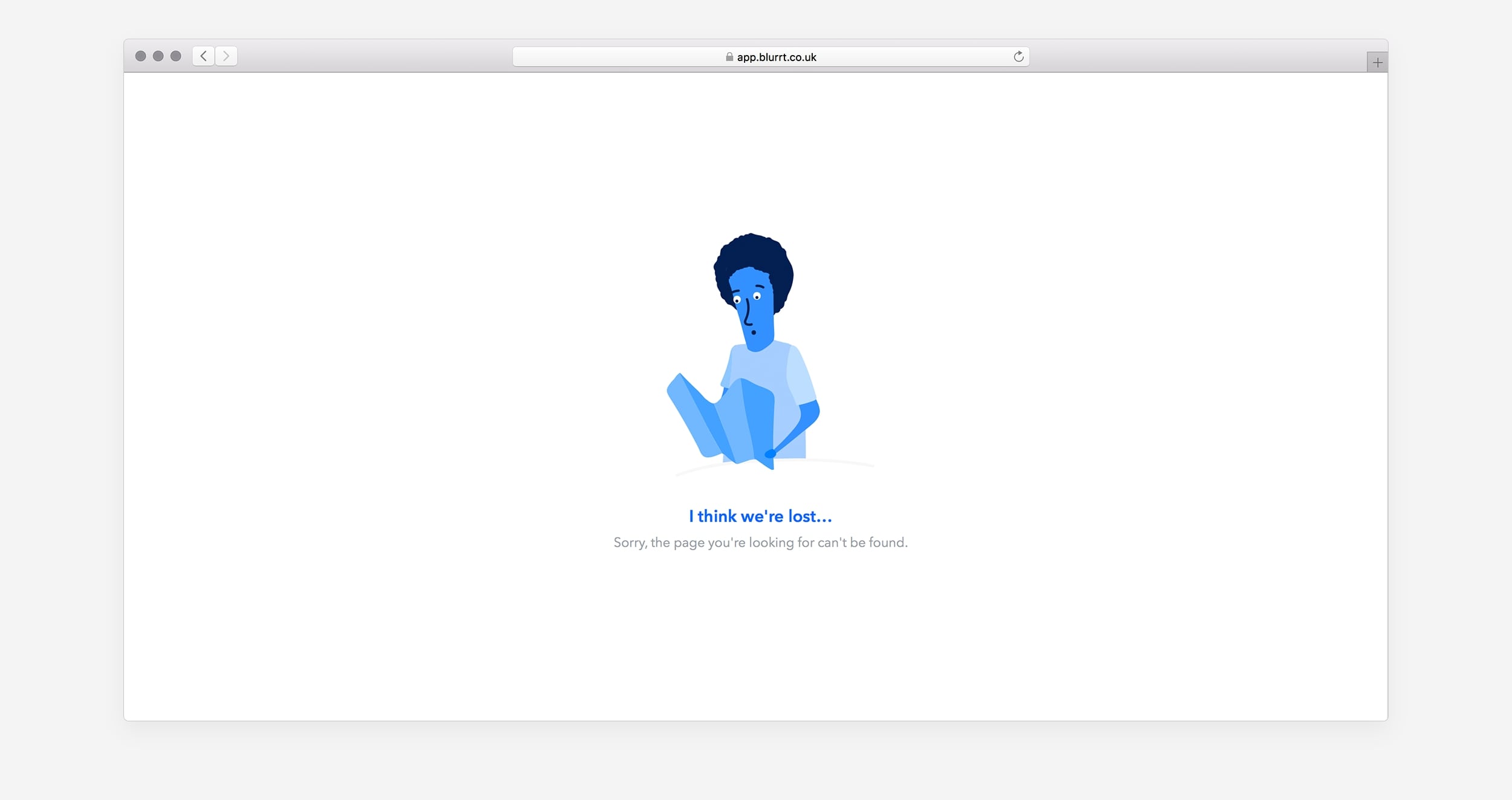
However, each sign seemed to lead only to another sign. And then another. Soon, we were back where we started. And then we found that the signs contradicted each other. This one says left, but that one before said that it was right. Is that one pointing downstairs, or just to the left? I’m pretty sure this sign is pointing towards an emergency exit.
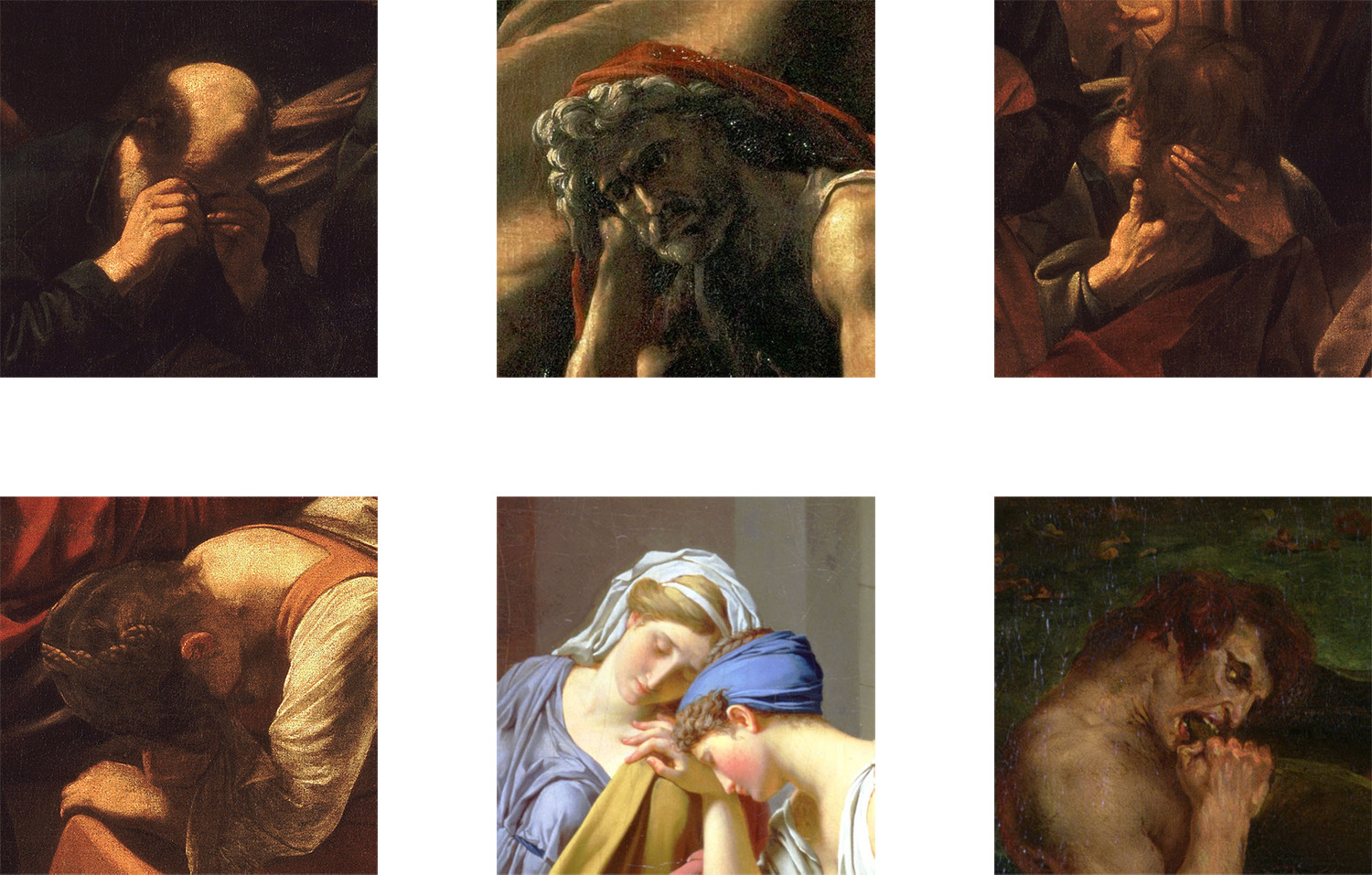
By this point, we had probably been looking for half an hour. We’d seen lots of nice art along the way, but now, it was starting to feel like every painting we saw was of us — each face painted centuries ago to reflect back at us our frustration and desperation.
In my tired, hungry, angry-at-the-Louvre state, I began to wonder — what if she isn’t here? What if that’s the point? Maybe there’s a great worldwide conspiracy and we’re now the latest to learn of it — that the Mona Lisa doesn’t exist. She exists only as reproduction. There is no original.
I knew it was a fanciful idea, but decided to follow it nonetheless. The Mona Lisa that we think of is not the one that hangs in the Louvre anyway. We are fascinated by the reproduction — by the fame that that reproduction brings. The real Mona Lisa — however masterful it may be — is just a painting. The only reason people want to look at the original — the reason that people fly halfway around the world just to see it — is in the hope that this experience will allow them to see the reproduction in a new way.
Where once it was a painting of a woman with a slightly odd smile, now it is no such thing at all. It has ceased to be a painting of a woman, and has become a painting of itself.
I might go one further — the Mona Lisa is now not even a painting of itself, but a painting of art in its entirety. It is a symbol for the institution that promotes genius as a commodity, that turns a thing of beauty into a thing that one must “understand”, that has made this 77 × 53 centimetre poplar board coated in oil paint worth more than, well, just about anything.
In 1911, the Mona Lisa was stolen by Louvre employee Vincenzo Peruggia — it sat in his apartment for 2 years before being found and returned to the museum. Throughout those two years, people still flocked to the Louvre to gaze at the blank space of wall where the Mona Lisa had once been. Billy Parrott suggests that it did not matter to those who went to see it whether the painting was there — everybody had seen its reproduction countless times before. What mattered was people being seen looking at it:
People standing in line, looking at an empty space on the wall. People looking at other people look at the empty space on the wall. Everyone knowing what should be there. Everyone knowing exactly what the thing would look like.
All this is not to say that there is no value in seeing the original Mona Lisa — there is, but to get to that value, one has to strip away all of the myth around her — what John Berger would call “bogus religiosity.” Instead, we have to learn to see the painting as simply that: a painting. A woman, as seen by a man, in a culture very different from our own. A man, trying to share with others that which he saw as beautiful.
Eventually, we found her. There she was, on a wall all by herself — the Mona Lisa. The original. A wall of bulletproof glass surrounded her, and a wall of tourists surrounded that. People shuffled around, trying to get closer to her, spending more time looking at their own personal reproductions of the painting in their phones that at the painting itself. They (and also we) were focused not on the Mona Lisa, but on how, by reproducing it, they would be seen by others as having looked at it. In the end, the Mona Lisa was in the Louvre — but maybe we weren’t.
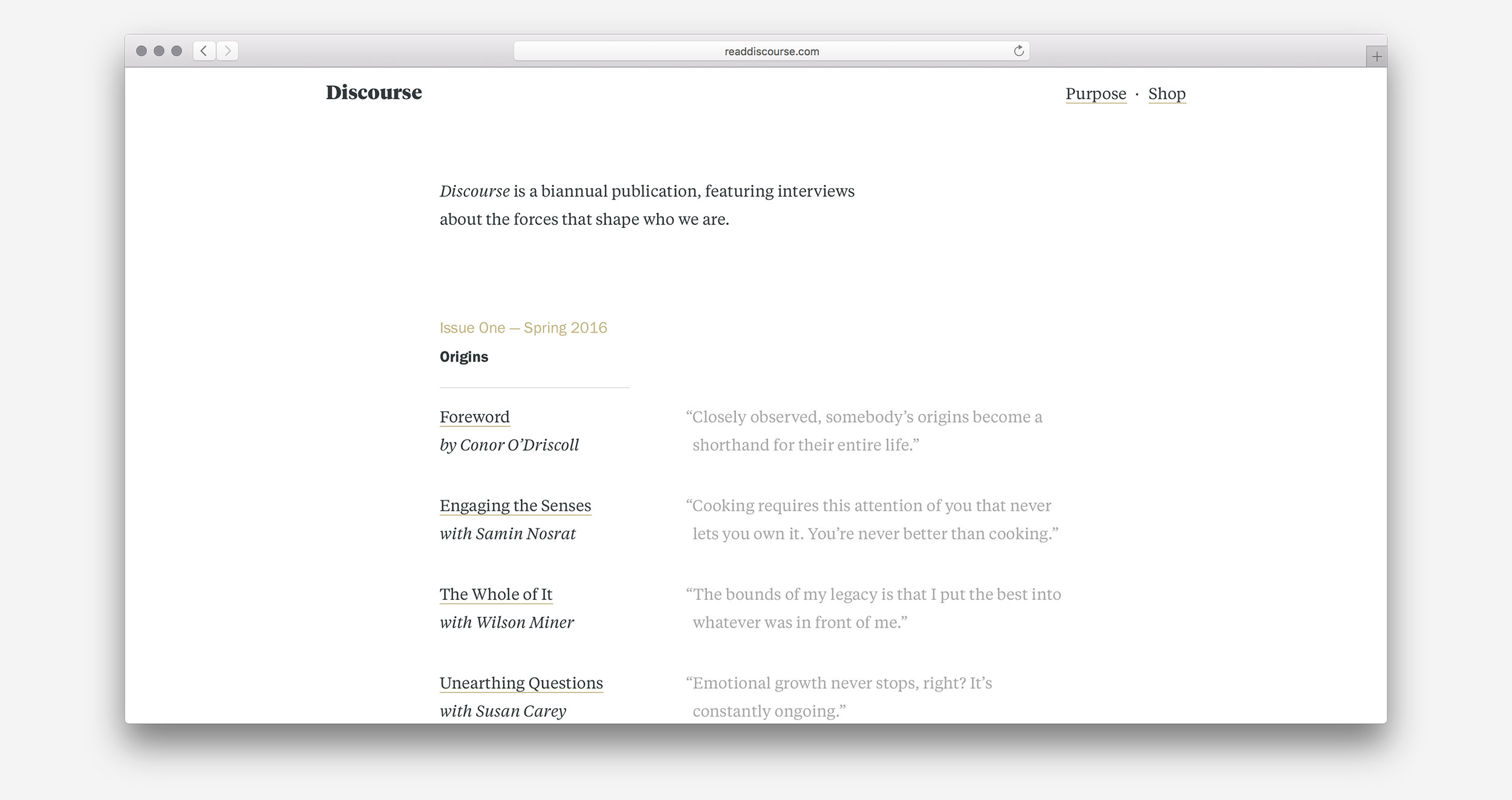
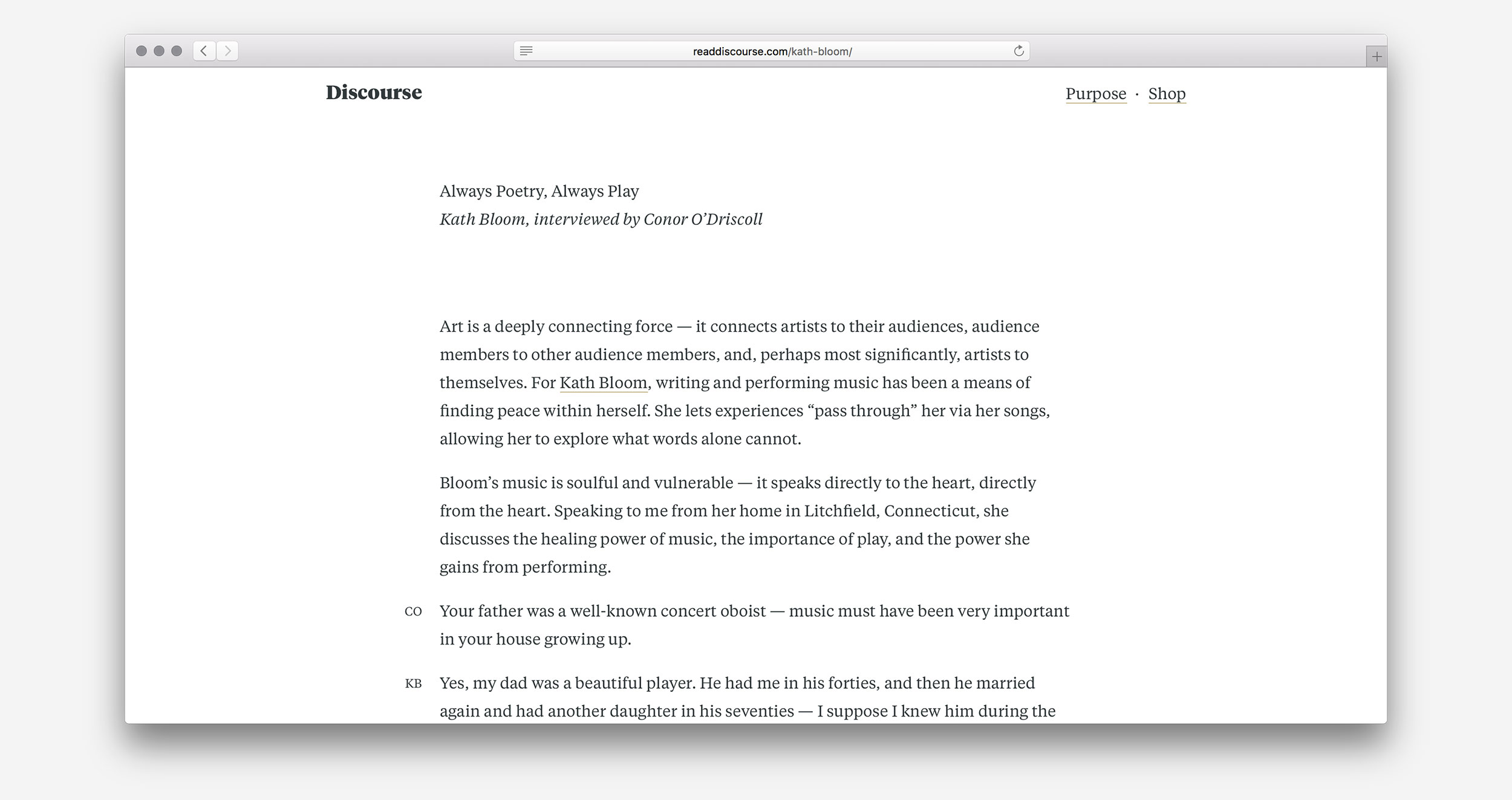
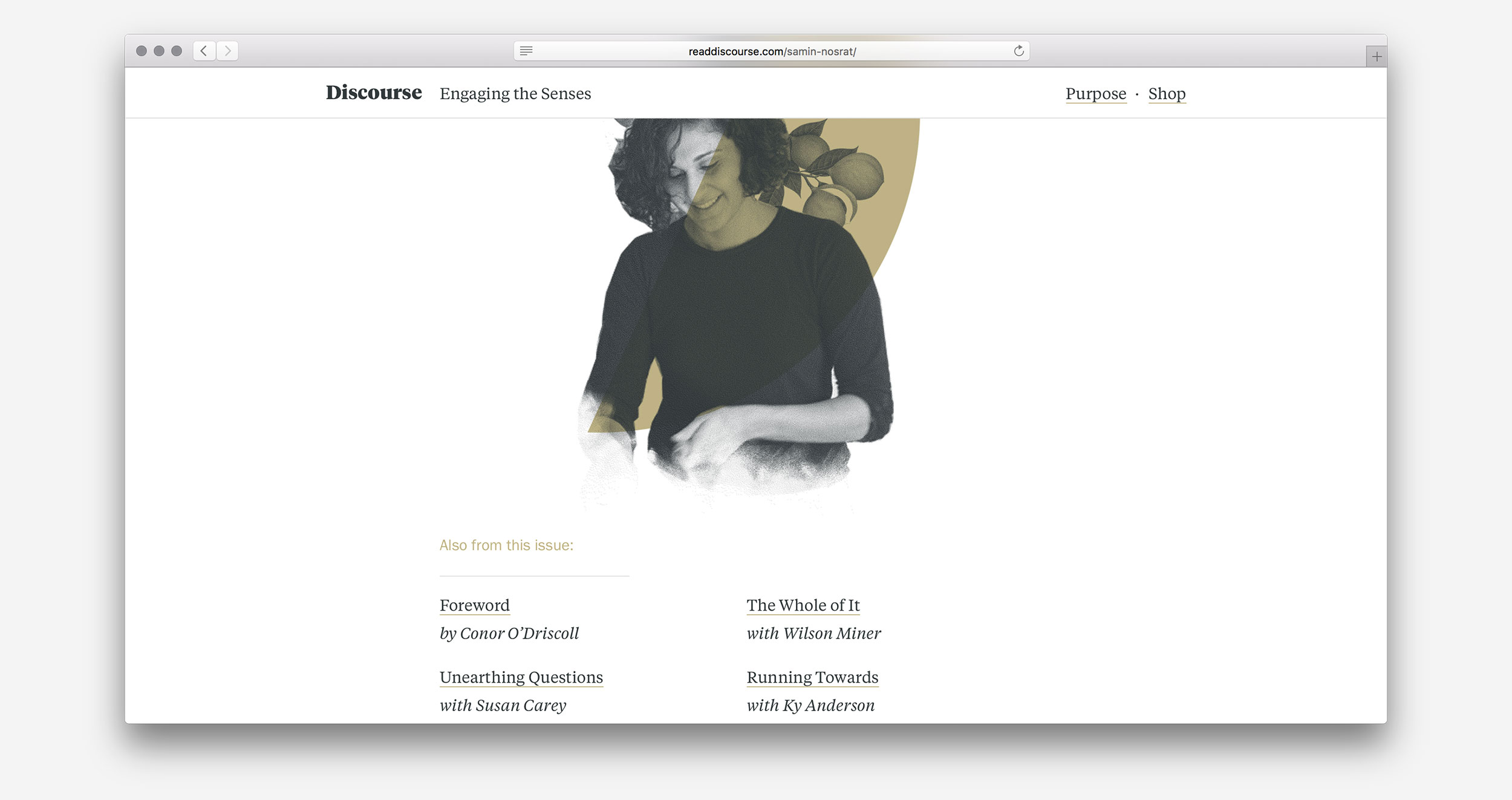
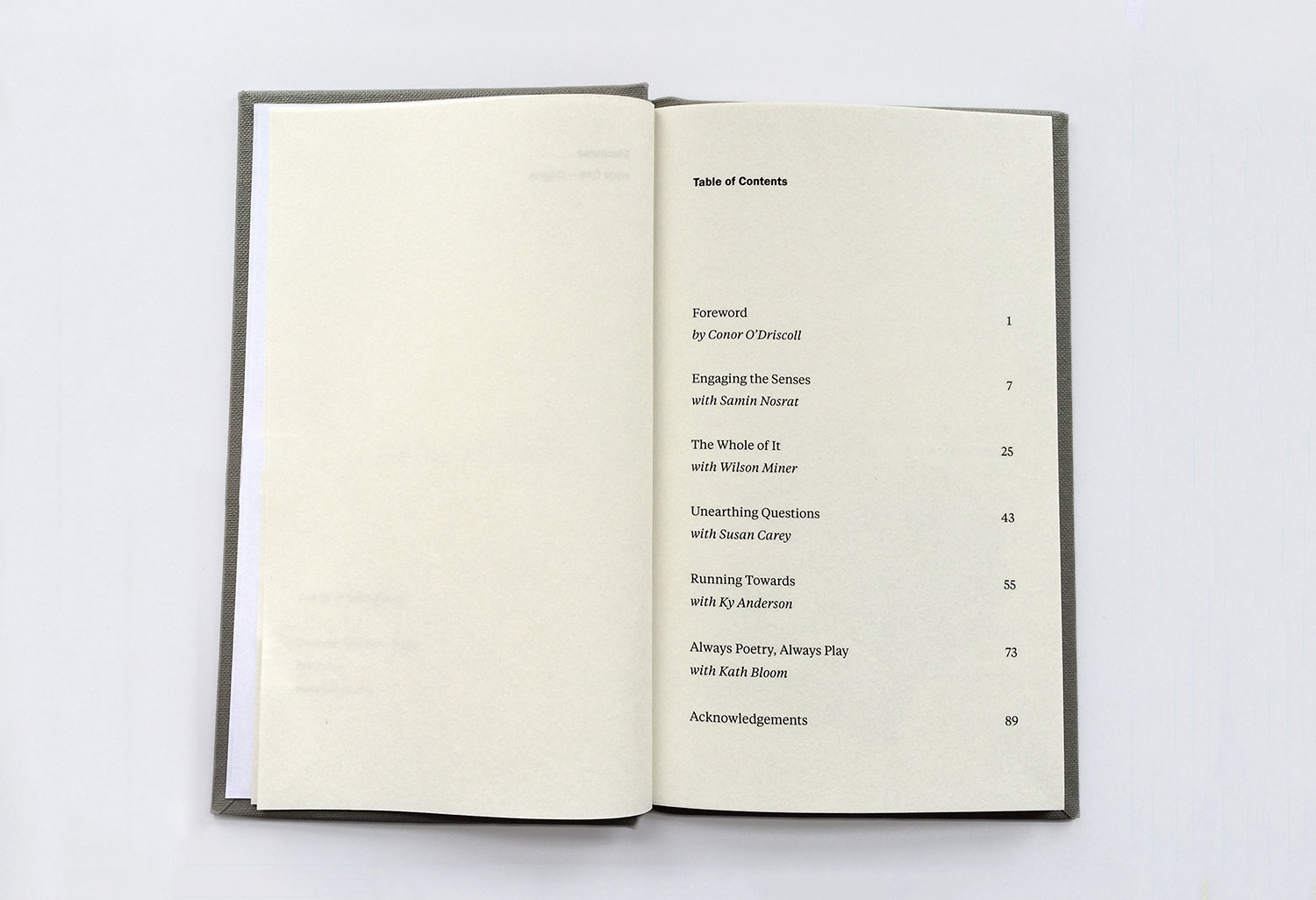
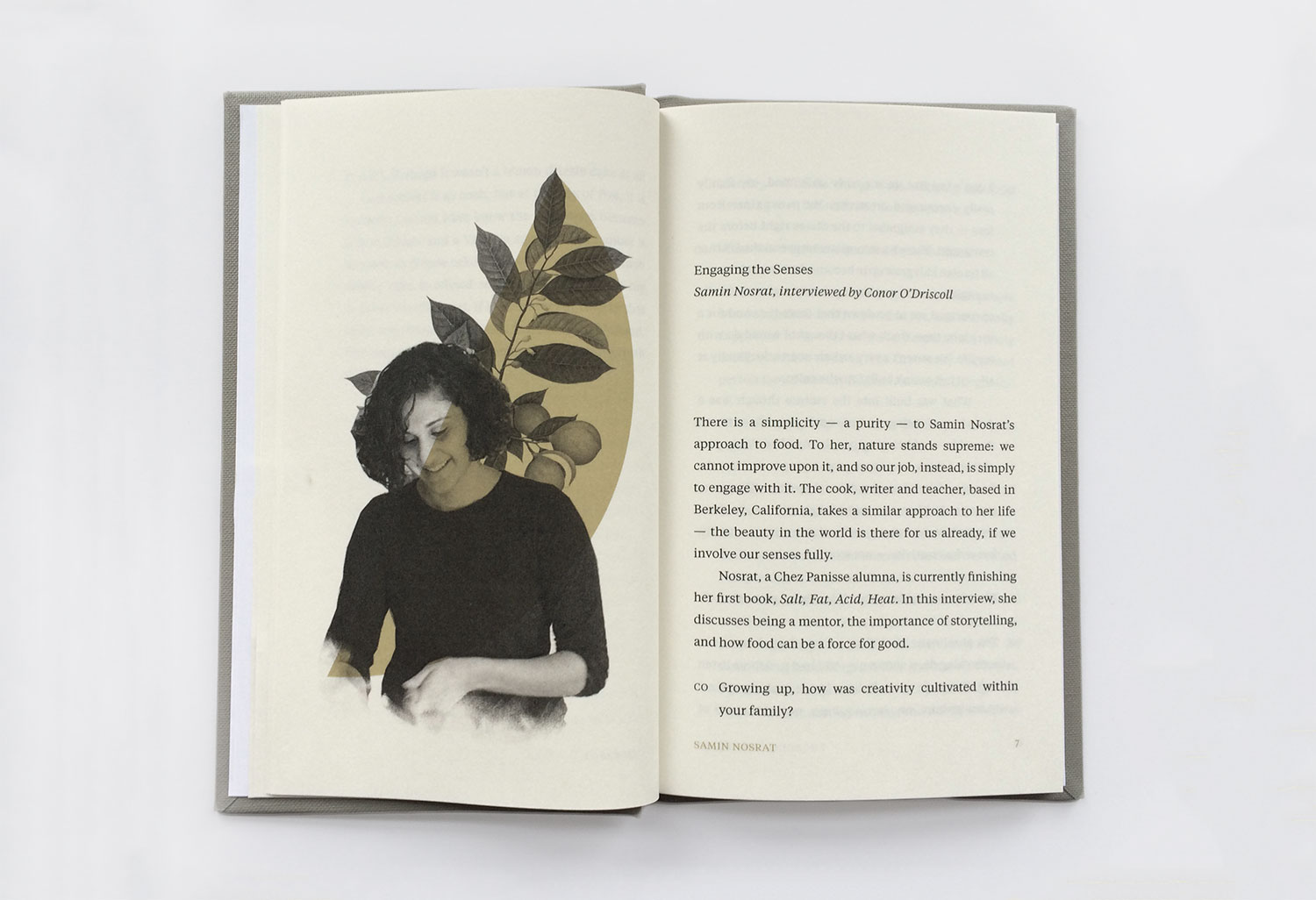
Discourse is a personal project — a publication, in both web and print, featuring interviews that explore the forces that shape the people we are.
The project is reflective and interested in big ideas — the design, as a result, takes a back seat here to let the content come to the fore. The website, in particular, is an exploration in stillness: when the rest of the web is so filled with activity and things pushing for attention, what does it look like when a website simply wants to… be?
Today, I woke up to a new world. We all did. I ate the same breakfast, walked the same commute to work, but the sense that things were very different now — a deep, silent, aching cry — sat solemnly in my stomach.
I awoke to feel a profound division within our society — a fissure which I’d known existed, but which only now could I truly sense, so wholly & so vividly. Donald Trump’s election into office was, of course, what caused me to feel this today, but that was just the latest in a series of events which have emphasised so clearly our deeply fractured world. I awoke to a similar feeling on the day after the UK’s EU referendum. That sensation arises again each time more innocent people are killed by the police. Each time, it is a struggle to remind myself that it is not a matter of us vs. them, no matter how much it may feel that way.
A community is a place in which people face each other over time in all their human variety: good parts, bad parts, and all the rest. Such places promote the highest quality of life possible — lives of engagement and participation.
The divisions that I feel in the world are clearly felt by so many others — and for lots of people, they are not just felt, but lived out. Today, my social media feeds have been awash with people crying out for ways to foster a sense of community and togetherness — something that right now feels so far away.
Community. It’s a word that’s everywhere right now, but a feeling that is very distant.
Reading Austin Kleon’s notes on John Taylor Gatto’s Dumbing Us Down, I was struck by the very clear distinction Gatto makes between networks and communities. Communities, Gatto says, are places that expose our humanity, in all its forms, whilst networks only take the bits of ourselves that they need, in order for the network to function:
Networks divide people, first from themselves and then from each other, on the grounds that this is the efficient way to perform a task. It may well be, but it is a lousy way to feel good about being alive. Networks make people lonely.
One of the strongest sentiments following the election result — one that follows almost every election result — is that sense of detachment from the other side. Our social media channels are filled only with people who agree with us. We hear of those who disagree, but filtered through the distorted lens of the media, or anonymised into poll samples — so rarely do we interact with them in a meaningful way.
Gatto is writing before social networks, before the internet, and yet his ideas feel all the more prescient because of them. He is writing about real-world networks — schools, companies, chess clubs — but social networks are built upon the same structures: they take the parts of ourselves that they need, and present them as if that were the whole. They split us up based on who we are and what we believe, with little thought as to the consequences of these divisions. We are now seeing those consequences.
If we are to turn this tide — to make people feel safe and welcome within their own countries — we need to think less in terms of networks, and more in terms of communities. How do we turn the systems in our lives — both online and off — into ones which open us up to more people — to wider perspectives — rather than closing us off into our own?
Networks are an important part of our society, don’t get me wrong, but it’s just starting to feel like that’s all we’re capable of creating. Where are the systems that erase boundaries, rather than putting new ones up? Systems that blur the lines between work and play, between productivity and idleness, between sincerity and humour, rather than enforcing them?
We’ve got enough divisions within our society right now. We’ve drawn enough lines. We need to start thinking about how to build up communities that rub those lines out. How do you forge a community that brings together people who would never normally interact? How do you build a community that constantly introduces its members to ideas that contradict and challenge their own? And how do you do this whilst still making these communities safe, welcoming places?
I want to repeat this until you are sick of hearing it. Networks do great harm by appearing enough like real communities to create expectations that they can manage human social and psychological needs. The reality is that they cannot. [They will] ultimately produce that odd sensation familiar to all city dwellers of being lonely in the middle of a crowd.
That feeling — of being lonely in the middle of a crowd — is one that will ring true for a lot of us today. It’s easy to feel that this is a vote against you. That the rest of the country has decided you’re not welcome, that you don’t deserve to be listened to.
You do. We just need to create the communities that will listen.
This piece originally appeared in Discourse, but I am reposting it here for posterity.
I am five years old, sitting in the kitchen with my mother. She has just spent half the day baking a lemon drizzle cake, which now sits on the rack in front of me, cooling. It’s a vegan lemon drizzle cake, she tells me repeatedly. For vegans. It’s a thing she is trying out.
I, she reminds me, am not a vegan. This cake, she is keen to emphasise, is not for me, because I am not a vegan.
And yet…
It’s sitting there in front of me. Moist and warm, steam still seeping out its gently-cracked top. I’m sure all the vegans are going to enjoy eating this very-definitely-vegan cake.
Brrrriiiiiiiiiinnnnngggg.
The phone rings in the other room.
Brrriiiiiiiiiiiiinnnnnngggg.
My mother tears off her rubber gloves and rushes out of the room, to answer the call.
She returns a few minutes later. I have, in these few short moments, moved out of my seat, and am sat on the table. A giant piece of the lemon drizzle cake sits in my hand, an even larger chunk in my mouth. Crumbs lie scattered around the kitchen, like debris after a hurricane. The cake is in ruins.
“Conor! What have you done?”
My mother, understandably, is not pleased.
I look up from my unplanned mid-afternoon feast with a glint in my eye. I know something that she does not. She thinks I’ve done something wrong, but once I explain myself, she will see that I am wholly in the right.
I explain, with my mouth still stuffed full of delicious lemon drizzle cake, “I— I’ve decided that I’m a vegan now.”
We do not become the people we are out of choice, but out of chance, and necessity. A particularly interesting lecturer in a class we accidentally walk into. A parent’s keen interest in astronomy. A tantalising lemon drizzle cake on a table we just happen to be sitting at.
When we talk about our origins, we are not talking about ourselves and the decisions we’ve made, but about everything else — all the other things that shape us. Our families. Our friends. Time. Place. The significant milestones and the everyday nothings.
Understanding somebody’s past is the easiest way to understand who they are today. These are the things that have had the longest to grow into a person’s identity — the parts of ourselves that are most deeply-rooted. We ask where somebody is from, or what the first record they bought was, in the hope that it will reveal their whole self to us. Closely observed, somebody’s origins become a shorthand for their entire life.
But the past, it is important to remember, is malleable. Whilst our origins inform the rest of our life, it is the rest of that life that informs how we perceive those origins. Stories are passed from person to person, between family members, then across families — eventually, it can be hard to decipher just what of our past is memory, and what is story. Perhaps it wasn’t a lemon drizzle cake at all — I remember it as such, but at the age of five, it is unlikely I would have know the difference between lemon drizzle and a Victoria sponge. I remember it as a lemon drizzle cake because my mother’s lemon drizzle cake is affixed so firmly, so vividly, to my memory of childhood. If I place another cake in that story, it no longer feels like a story of my childhood. The memory of a past, perhaps, reveals more truth than the actual facts do.
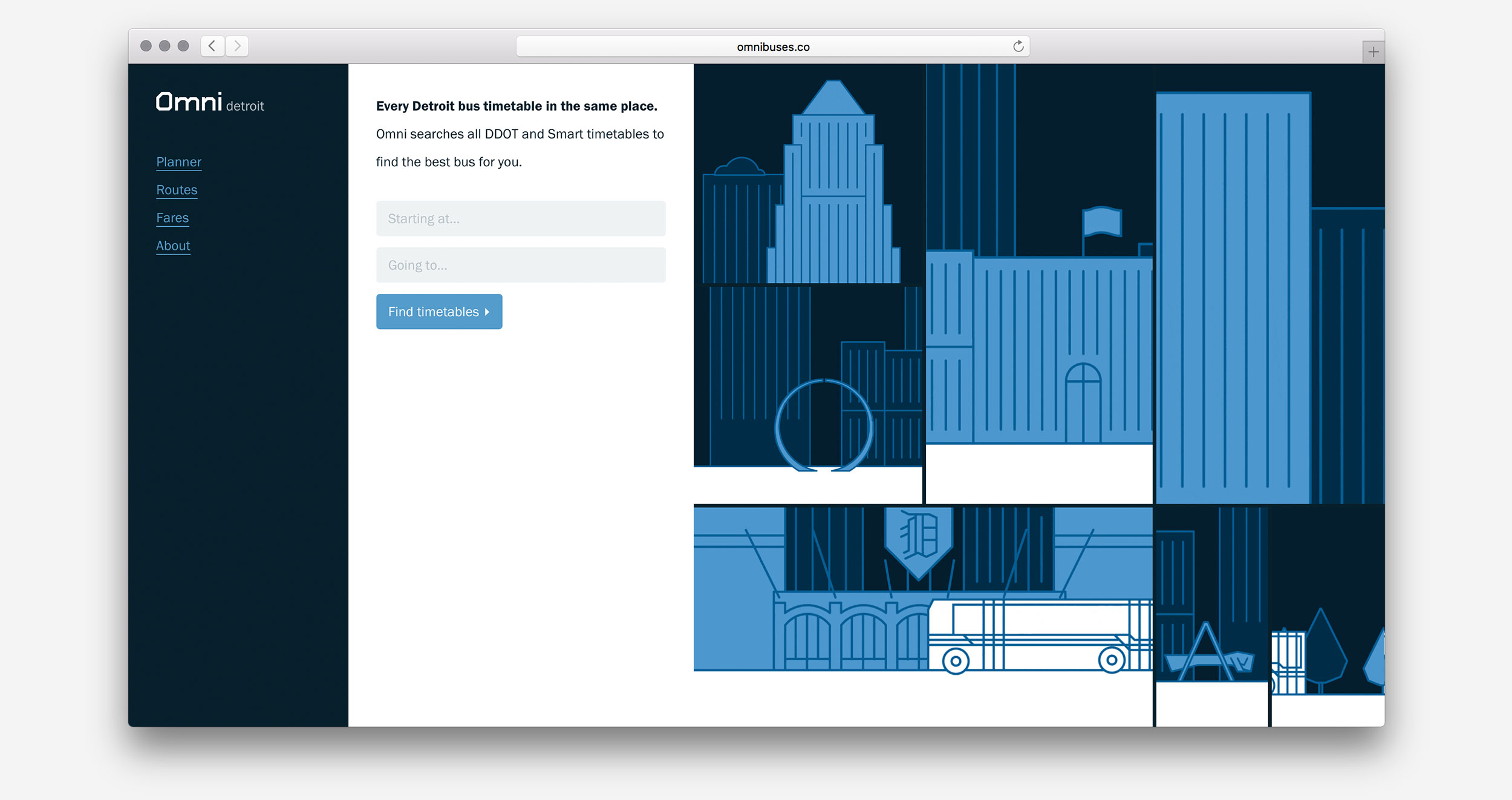
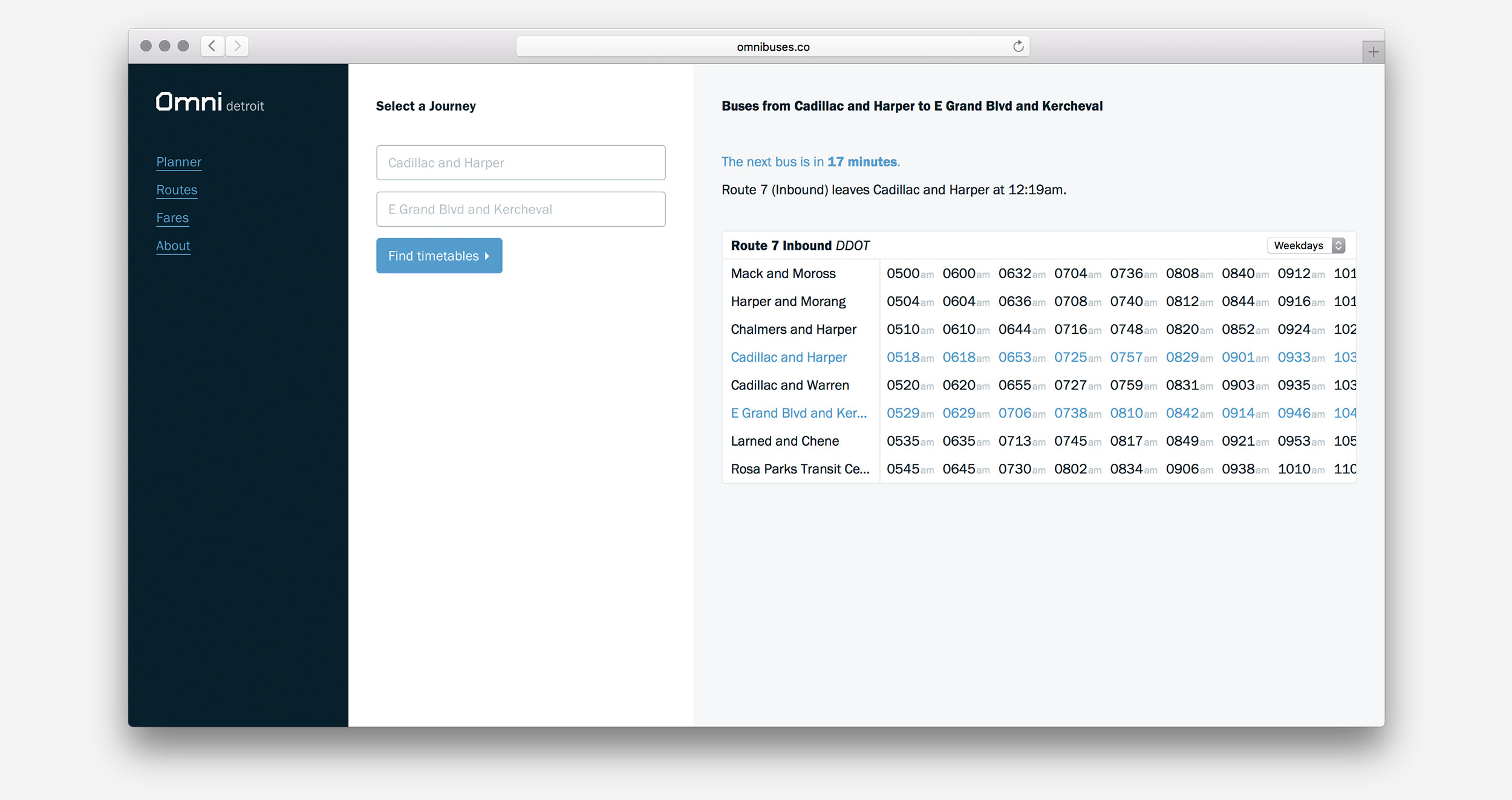
Omni is a web app that allows Detroit commuters to easily access any bus timetable within the city, by compiling all DDOT (Detroit Department of Transport) and Smart bus services.
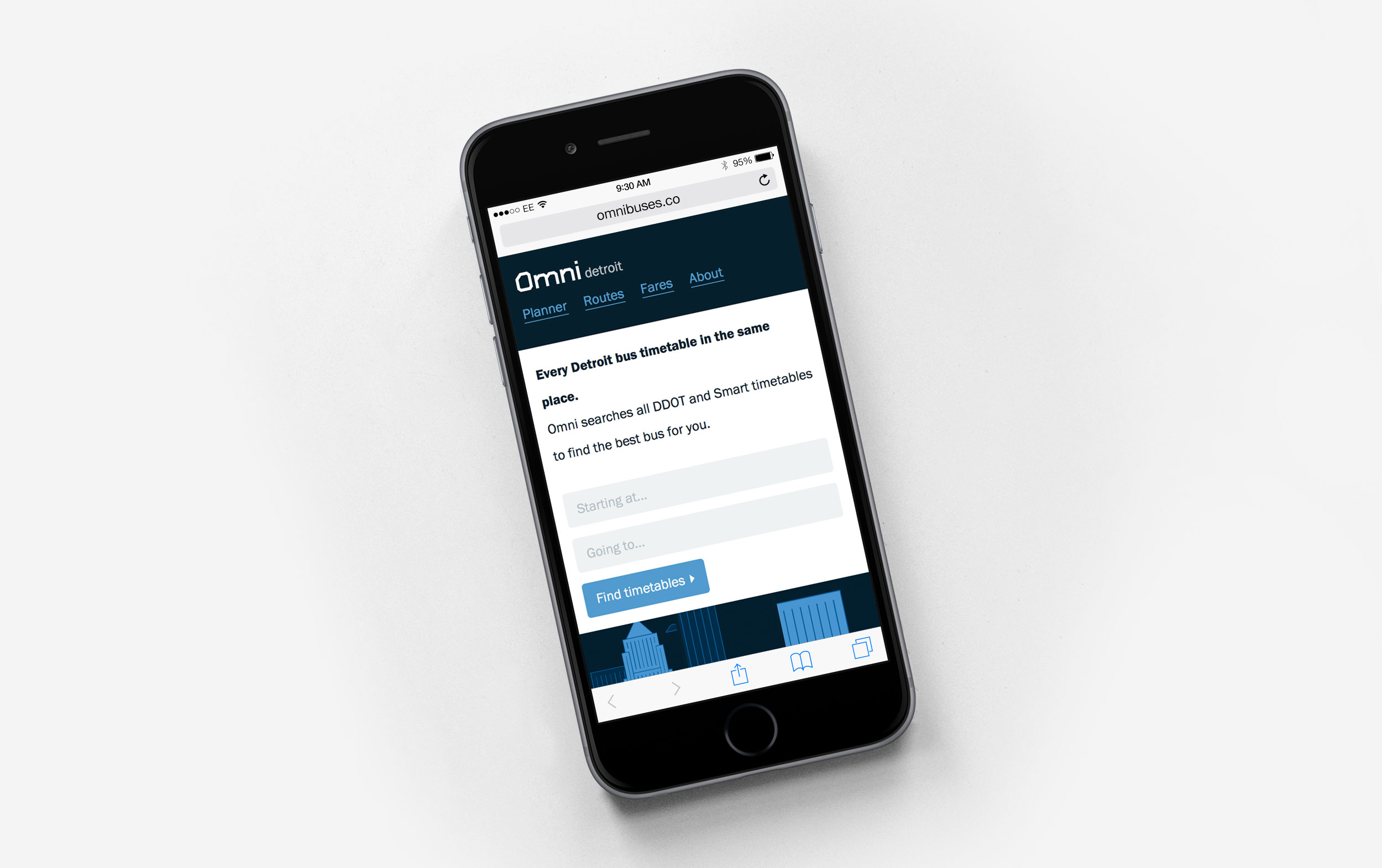
The site pares down the public transport experience, to make finding a bus timetable as quick and as user-friendly as possible. It also features a fully responsive design, to ensure that users can find a timetable on mobile as easily as they can on a desktop.